As of late, sunflowers and samurais have been very meaningful to me. What do sunflowers and samurais have to do with one another you may ask? Both provide a picture of the dance between death and life. If you’ve been following this blog, you know that a major theme it touches on is life coming forth from death, beauty from ashes. The metaphor we have been using for this theme is the desert. In the desert, I have encountered the most barren of wastelands, but also the most beautiful, star filled skies and the silence that whispers the song of eternity to the soul. The sunflower and the samurai contain similar themes.
Sunflower Fields and Colorado
The connection in my mind between samurais and sunflowers began back in July this past summer when I was in Colorado. I was visiting with a friend and helping him move some items from Tennessee to Colorado. It was a long drive, but I love long drives, especially out West. Most people do not like having to drive through the flat parts of Kansas and the first half of Colorado to get to the mountains because of how flat it is. Personally, I enjoy how flat and open it is because of the sunsets and the flower fields. Anyone that knows me knows how much I love sunsets over the ocean, but sunsets over flat plains and flower fields is a another story. Sunsets in different situations tend to say different things to the soul. When the sun sets over those endless plains and its mandarin spears pierce your soul and highlight the expanse above in hues of peach and rose, you quickly forget the separation between earth and heaven. I don’t know how many times I have imagined taking off running, sprouting wings, and flying away into that expanse like an eagle, to see an ocean of flowers below me sparkling like a Monet painting and dancing in the ripples and currents of the prairie winds.
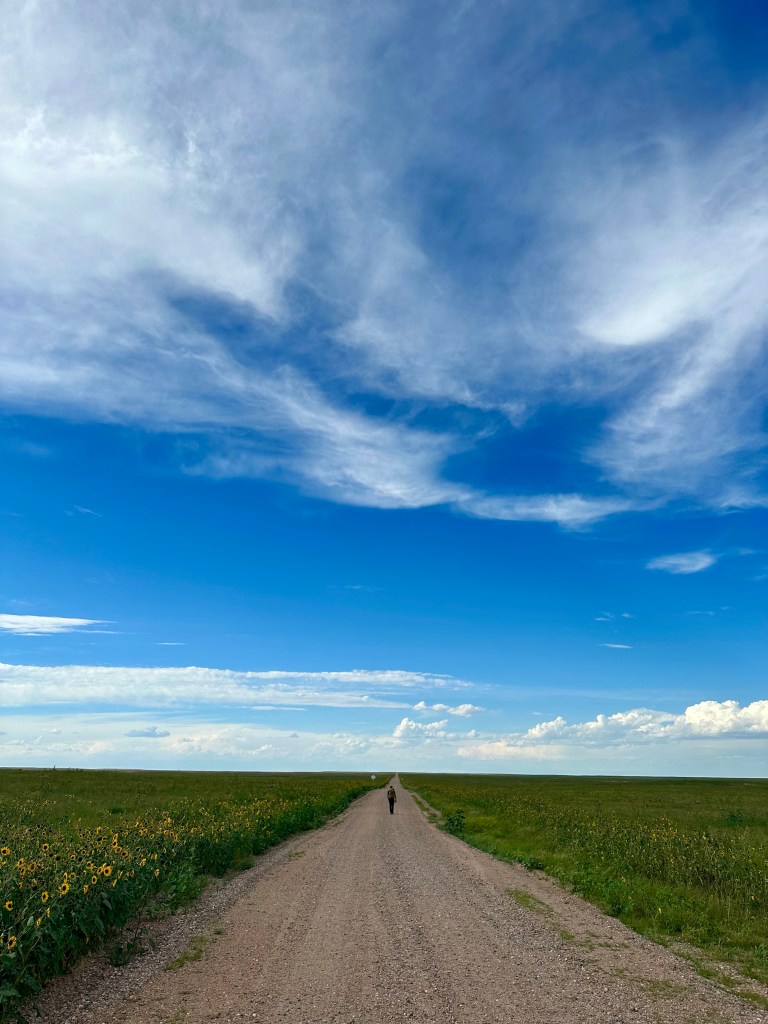
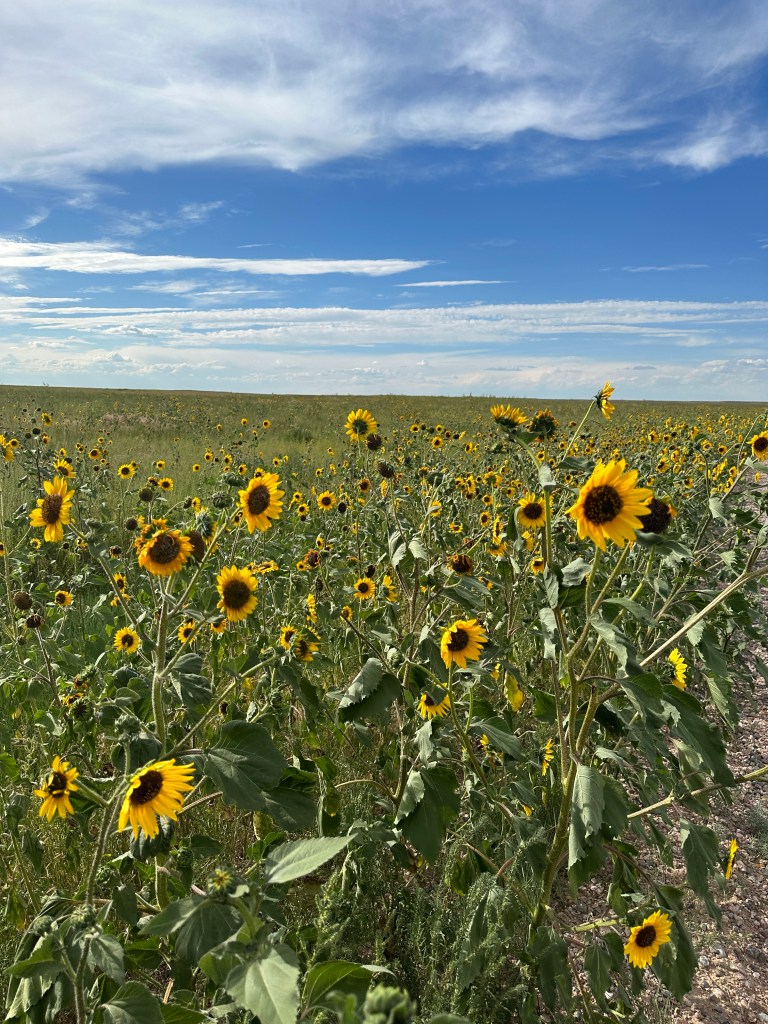
As we approached our destination, the Rockies began rising in the distance telling us the plains were soon coming to an end. Instead of taking the interstate through Denver, we went a back way that took us past one of the most beautiful flower fields I have ever seen. It was a field of sunflowers that stretched as far as the eye could see. We had to pull over to check it out! There was a road that went straight off into the fields and seemed to go for miles and miles. Everything in me was screaming to walk down this road to see where it went, but alas, we only had a short time. I fully plan on returning to that location to see what is down that road. The sky that day was the perfect azure blue with a few clouds. The wind was blowing very gently, with a mild gusts, causing the sunflowers to dance back in forth as if they were telling us to lean in and listen, making it one of those moments where whispering felt more appropriate than talking out loud.

The Soil of the Soul
As the week went on, I couldn’t get that moment out of my mind. I started thinking about sunflowers and fields, as well as farming and planting. All are very similar to what the Lord does with our hearts to draw us closer to Him, to home. In Scripture, we see Jesus use the parable of the sower as a metaphor for the condition of our hearts (Mt. 13:1-23). When we are presented the Truth, the Truth is like a seed sown into our hearts and our hearts are the soil. In the parable, the seeds that fell along the path were snatched away by the evil one because they were not able to take root (Mt. 13:19). The seed that was sown among rocky ground heard the Truth and immediately received it with joy, endured for a while, but withered away when trials arose because he who had the rocky ground had “no root in himself” (Mt. 13:21). The seed that fell among thorns was choked away by the thorns, representing those who hear the Truth but are led away by the cares of the world (Mt. 13:22). As for the seed that fell on the good soil, Jesus says, “this is the one who hears the word and understands it. He indeed bears fruit and yields, in one case a hundredfold, in another sixty, and in another thirty” (Mt. 13:23).
How to Make the Soil of the Soul Good Soil
How do we have good soil? Good soil does not just appear on its own or overnight. If we want the abundant life that Jesus came to give us, the soil has to be prepared so that when we hear the Truth, we are ready. To become good soil is a painful process. All of us come from different situations. Some of us have rocks and thorns in our fields due to evil that has been done against us, or the evil we have done to ourselves and others. Many of us are content to leave the soil rocky or thorny because turning bad soil to good soil can cause deep pain.
When I was in middle school, my parents wanted to plant a big garden in the back yard, so my grandpa came over to teach my brothers and I how to plant. Before any of that, we had to prepare the ground. We didn’t have any machinery, so he taught us the old-fashioned way. We took rakes, hoes, and shovels to prepare the ground. When I was little, my grandmother instilled in me a joy to watch things grow by teaching me about planting in her greenhouse. Because of this, the backbreaking work of planting a garden was addicting. After my grandpa taught us what we needed to know, I would go back out in the yard for hours on my own to get the ground ready. I used a pick to break the ground up, then used the hoe to plow the rows I needed. Then, I cleared out the rocks and any debris that could hurt the plants. After that, I used different fertilizers my grandpa showed me to spread across the ground to pack the soil with rich nutrients. Finally, I was ready to make the holes for the seeds. For this part, I used my hands. After hours of digging holes with my hands, my fingers were cut and bleeding, but I was deeply satisfied with the work. Over the next several weeks, I was elated watching the seeds I planted sprout, grow into stalks, bloom, and yield fruit.
For the soil to become healthy, roots have to be cut, the ground has to be broken, and rocks have to be removed. Now, think about this with the heart. For our hearts to be healthy, the roots of trauma and mistakes producing harmful thinking patterns and behaviors have to be cut and ripped out. Plants that are cut experience a burning sensation. Rocks of certain memories lodged in the soil have to be pulled out and cast away. The continuous strike of the pick and the hoe will leave our muscles sore and our backs aching. When our bodies and hearts are ready to heal, it can be quite a sudden shock to the system. Many times, it can seem that healing from the circumstances that caused our pain can be more painful than the circumstances themselves. As a result, we are content to leave our fields as fallow ground. Reflecting on this has convicted and challenged me to identify where fallow ground may lie in my heart.
If we are willing to go through the pain of tilling, the soil will be ready and nutrient rich. Even when the seed is ready to be planted, there must be one final, painful act. The seed must die in the darkness of the soil before it is ready to sprout life. Similarly, we must die before we can be reborn. Jesus is the farmer, the shepherd of our souls who masterfully and tenderly tills the soil of our hearts if we allow Him to, calls us to pick up our cross and die to ourselves (Mt. 16:24-27). We fear Him tilling the soil of our hearts, lest we lose all we have known, all we have become comfortable with. Yet, if we will open the door and invite Him in the dark places, the places He wishes to meet us, He will come in and dine with us (Rev. 3:20). In the dark places, there is a feast to be had from the fruit of those fields. It is no mistake that Jesus gave us a meal to remember Him by on the eve of His death. This meal consists of two items produced from the field, the fruit of the vine representing His blood and the broken bread made from fields of grain, representing His body broken for us. Through ministry, Jesus has been teaching me the significance of what He has done for us and is doing for us.
Lessons from Ministry: The Patient Pursuit of the Farmer
In various forms, I have been in ministry for the last ten years. Like planting, it can be back-breaking and discouraging work helping till the soil of people’s hearts. I have often felt the brokenness of the Father for His children and for those He wishes to be His children. There are many mornings I have woken up thinking, “I don’t know how much more I can give.” Time and time again He proves His faithfulness and sustains me with His strength in my weakness. No matter how discouraging it can be, there are also those days where my joy is full because I catch glimpses of the harvest as I see the people He has placed in my care grow and long for what God has for them. Then I think, “This is worth it.”
More importantly, the work of ministry has shown me how the Father patiently pursues us over and over again even when we push Him away. He continually shows us kindness and removes the roots and the rocks that are keeping us from Him. When I find myself becoming frustrated or hurt at others for not growing or responding to the investment I’ve placed in them, I find myself convicted wondering if that is how Jesus has felt with me in times I have resisted His pursuit of me, when I have pushed way His offer to till the ground in the places that need to be broken up. I have found that the irony of putting walls around my heart to protect myself from pain in the past also put a barrier between being loved and giving love. Yet, He continuously scales my walls and smashes them down. He is good indeed, much more good than I deserve.
The Lesson of the Sunflower
As I was thinking through all these farming metaphors, I was also thinking about sunflowers and what makes them special, so I started doing research. I found that the sunflower is often used as a symbol for looking to Christ. Sunflowers try to capture as much sunlight as possible by looking to the sun and following it throughout the day. Similarly, we are to always look up and look to Him, basking in His glory and Truth, allowing it to define every bit of our being. Psalm 34:5 tells us, “Those who look to Him are radiant, and their faces shall never be ashamed.” Like any seed, a sunflower seed must die before it can be born. As it grows and blooms, it follows the path of the sun. To me, this kind of stuff in nature fascinates me. In my classroom I placed a vase on a table that I consistently keep sunflowers in to remind me of all the things God has been teaching me through sunflowers and planting. However, doing this caused a problem. I noticed that even though I put the sunflowers by the window so they could follow the sunlight, some would turn to the light but others would consistently turn the opposite direction and face away from the light. I started thinking, “Am I wrong as well as everything I have read about how they follow they light?” For a little bit, I didn’t think much more about it.
Later, I started doing more research on sunflowers because I wanted to know how to plant a sunflower garden. I looked up the right time, the kind of soil it needs, and how they need to be spaced. Then, I came across a very interesting fact about sunflowers that blew my mind. One article pointed out that you need to pay attention to what side of the house or fence you plant them on because mature sunflowers stop following the sun and instead constantly face the East. If you plant them on the wrong side, they will face away from you as they grow. As sunflowers mature, their stalks become stiff. Because they are less flexible, they fix themselves to look where the sun will rise. Upon learning this, the light bulb went off in my mind as I thought back to the “problem” I had witnessed in my classroom with my sunflowers. Through this, another beautiful layer of Truth was unveiled to my soul.
With the current conflict in Israel, my heart has been very heavy and broken for Jews around the globe. My mind and my prayers have consistently been on Jerusalem. As believers, we are told to pray for the peace of Jerusalem (Ps. 122:6). I deeply love the Jewish people because without them, I wouldn’t be here. If you are a follower of Jesus, your heritage is their heritage and He has not given up on His people. When I started thinking about how mature sunflowers consistently face east, I thought about the new Jerusalem promised in Revelation 21, the future home of those who belong to Jesus. Then my mind drifted to some of my favorite verses in all of Scripture, Hebrews 11:13-16:
“These all died in faith, not having received the things promised, but having seen them and greeted them from afar, and having acknowledged that they were strangers and exiles on the earth. For people who speak thus make it clear that they are seeking a homeland. If they had been thinking of that land from which they had gone out, they would have had opportunity to return. But as it is, they desire a better country, that is, a heavenly one. Therefore, God is not ashamed to be called their God for he has prepared for them a city.”
Hebrews 11:13-16 is placed in the middle of the Hall of Faith. The Hall of Faith lists many of the major characters of the Bible and the great exploits they did through faith in God and His promises. Through faith they “conquered kingdoms, enforced justice, obtained promises, stopped the mouths of lions, quenched the power of the sword, were made strong of out weakness, put foreign armies to flight. . .” and the list goes on (Hb 11:33-34). How were they able to do such things? They were constantly looking to home, the city that was to come. It was their consistent gaze towards home, their consistent tuning into the frequency of eternity’s song that lit the fires of their faith. This faith also allowed them to endure the dark by suffering mocking, flogging, and imprisonment (Hb. 11:36-37). They conquered the darkness of their souls, the dark nights of life, and the darkness of others because they were always looking to the East. Likewise, the sunflower waits in the dark of the night, looking to the East because it knows the sun will rise again.
Like Jesus, these people were rejected and faced hardship. We are not exempt from this call, for like Him we are told to go outside the gate and meet Him outside the camp “and bear the reproach He endured. For here we have no lasting city, but we seek the city that is to come” (Hb 13:12-14). In this passage, we not only see that we are looking to a place, but a person. The powerful faith Hebrews speaks of is gifted to us by Jesus, the founder and perfecter of our faith. Hebrews 12:1-2 tells us, “Therefore, since we are surrounded by so great a cloud of witnesses, let us also lay aside every weight, and sin which clings so closely, and let us run with endurance the race that is set before us, looking to Jesus the founder and perfecter of our faith, who for the joy that was set before him endured the cross, despising the shame, and is seated at the right hand of the throne of God.” We look not just to a place, but a person.
Samurais and Sunflowers
This is where the samurai piece comes in. What on earth do samurais and sunflowers have to do with each other? As someone who loves Japan, I have spent a lot of time reading about how the way of the samurai (Bushido) has influenced Japanese culture and history. For me the ferocity of the samurai in battle and the unparalleled loyalty they show to their masters have been motivators in how I approach my work and life. The way of the samurai is the way of death. In Hagakure: The Book of the Samurai, the samurai is told, “Meditation on inevitable death should be performed daily. . . . and every day without fail one should consider himself as dead.” Hagakure was compiled by Yamamoto Tsunetomo as a spiritual guide for how samurais were to think about life, death, and battle. By having to daily think about what they feared the most, it was believed that the samurai would embrace death rather than run from it on the battlefield, sharpening their focus and refining their senses. This made them ferocious warriors, which is a reason they are revered by studiers of military history. A samurai’s goal was to die an honorable death because it was believed in the afterlife, he would re-incarnate and serve the same master (https://www.historyoffighting.com/death-of-a-samurai.php). The path of death was seen as a way to life, not the end, but just the beginning. Although there are some similarities between this view of death and the Christian view of death, there are some huge differences between the samurai’s view of death and shame and my view as a follower of Christ. I will touch on more of that later.
Like the sunflower, the samurai must die before he can be born again. Also like the sunflower, the samurai were meant to be a symbol of beauty and life. The samurai were not just warriors, but poets, authors, thinkers, and artists. Similar to David, they were warriors and artists. David did not just fight with the sword, but waged war against the enemies of his soul with his pen and harp, not realizing his songs and poetry would be the weapons of warfare for generations of believers. All this to say, samurai were what we consider a “renaissance man.” They embraced all life had to offer because they embraced death, recognizing how short life is. They were expected and instructed to constantly till the soil of their hearts by rooting out anything that could keep them from their destiny on the battlefield and the way of their masters. In Psalm 90:12 the psalmist writes, “So teach us to number our days that we may get a heart of wisdom.” Solomon wrote in Ecclesiastes 7:1-2 that the day of death is better than the day of birth and that “it is better to go to the house of mourning than to go to the house of feasting, for this is the end of all mankind, and the living will lay it to heart.” Solomon is not telling us to be obsessed with death, rather to truly live we have to face death. In the face of death, we are forced to consider meaning, why we are here. There is a huge difference between just being alive and living. There are many who are alive, but are the walking dead in reality. Additionally, we are to have unmatched loyalty of the samurai to the One whom we will be serving for eternity, setting our face like flint, “But the Lord God helps me; therefore I have not been disgraced; therefore I have set my face like a flint, and I know that I shall not be put to shame” (Isaiah 50:7).
Perhaps when Isaiah wrote that, he was thinking of the desert, specifically the black lines and spots of flint that run through the rocks of the Negev Desert and the Judean Wilderness in Israel. In Matthew 4:1-11 Jesus was led “by the Spirit” into the Judean Wilderness. There He was tempted by Satan to depart from the mission that God had sent Him to accomplish. When flint is struck by steel it sparks because it is harder than other rocks. Flint does not break easily. Like flint, Jesus set His face towards home and His Father. He was unbreakable and did not turn to the right or the left because He was so deeply anchored in His identity and purpose. Like the samurai and the sunflower, He died and was laid in the darkness of the earth. He did not stay dead but rose again to new life to be the first fruits of the harvest to be reaped later, the raising of God’s children to new life (Rm 8:18-25, 1 Cor 15:50-58).
Unlike the samurai, we will not be caught in an endless cycle of reincarnation for it is appointed for man to die once (Hb 9:27). If we are to die once, there is also coming a day when Christ will raise us to life once and for all. After that death comes judgement, “so Christ having been offered once to bear the sins of man, will appear a second time, not to deal with sin but to save those who are eagerly waiting for Him” (Hb 9:27-28). In other words, Jesus will come to save those who are waiting in the dark, looking for the sun to rise. Also, unlike the samurai we do not have to be afraid of dying dishonorably and recklessly run towards death, for if we are truly in Christ we can live the fullest life here and now for His glory because He has dealt with our shame and nailed it to the cross (Hb. 12:2, Hb. 4:16, 1 Jn 1:9, Rm. 5:3-4). Although death is the gateway to be with the Lord our life is not our own and we do not get to choose when to take it. Jesus came to give us abundant life not just for later, but now. Like Paul we must recognize that it is not our time until we have completed our mission and brought home everyone we were meant to:
“I eagerly expect and hope that I will in no way be ashamed, but will have sufficient courage so that now as always Christ will be exalted in my body, whether by life or by death. For to me, to live is Christ and to die is gain. If I am to go on living in the body, this will mean fruitful labor for me. Yet what shall I choose? I do not know! I am torn between the two: I desire to depart and be with Christ, which is better by far; but it is more necessary for you that I remain in the body. Convinced of this, I know that I will remain, and I will continue with all of you for your progress and joy in the faith, so that through my being with you again your boasting in Christ Jesus will abound on account of me.” Philippians 1:20-26
Recently, I connected samurais and sunflowers because of a picture that came to me in my mind. For a while, I had a phone background of a samurai bowing with his sword in in the ground in a grassy field. In the picture, tears were streaming down his face falling into the grass. I imagined this same picture, except the samurai was holding a sunflower and his tears were reaping a harvest among the nations. Lately, I have taken up sketching as a new hobby. I ended up drawing this picture to keep as a reminder of who God has called me to be. In the picture, the stalks of grain have attached to them the flags of various nations, as the tears of the samurai are watering them. I called it “The Weeping Sunflower Warrior.” When it is time for a sunflower to die, it drops its seeds into the ground. Similarly, the tears we shed when we face seasons of death in this life will reap a bountiful harvest. Until it is time for us to leave this earth, we are to look up and look East as we look to the Son.
Fields Below Denver
So my friends, to tie it all together. . . before we can be like the samurai and the sunflower, the soil of our hearts have to be ready. We must allow the Master to take the blade of his pick to the roots that are hurting us. We must allow His gentle, strong hand to dislodge the rocks embedded deep in our souls. We must allow Him to place His yoke upon us, to plow the fallow ground, for He is “gentle and lowly in heart” and in Him we will find rest for our souls (Mt. 11:29). His yoke is easy and His burden is light (Mt. 11:30). When the soil is ready, we can die like the sunflower seed and be raised to new life and spread our petals to soak in the life-giving warmth of the Son, standing as a reflection to all who pass by as a testament to His beauty and worth. Together, like a field on the backroads of Colorado, we can call to those who pass by to stop and ponder why they are here and to Whom and where they are headed. If we pick up our cross, and die to ourselves to live for Jesus, we can be like the samurai and pick up our swords, running into the heat of battle, fueled by unmatched loyalty to our Master, having no fear of death because there are precious souls to wage war for, souls to be freed from the kingdom of darkness. We can fight without shame, because our shame has been dealt with.
When it came time for me to leave Colorado, my flight back to Knoxville got cancelled and I was stuck in Denver for two days. Usually when those interruptions happen, the Lord has work for me to do. I asked Him to send me anyone He needed me to talk to during my extended stay. He sent me five different people I was able to share His message with. Even on the way back, I had to fly to Asheville instead of Knoxville and had the privilege of sharing my faith with someone who was searching for meaning and had very many good questions. As I stepped onto the plane, tears came to my eyes because I felt as if I were stepping off the battlefield after a mission accomplished for my Master and my heart could hear Him saying, “Well done.” Looking out the window of a plane during take off NEVER gets old for me. I’m also that annoying person that keeps the window open most of the plane ride because I can’t quit looking through it like a little kid. When you fly out of Denver, the first thing you see is an endless stretch of squares and circles, miles of fields. Looking down at the fields below, I couldn’t’ help but listen to “Fields” by Andrew Word. The Lord greatly encouraged me in this moment. It has been a very dark season. Even though leading up to that trip I felt exhausted and discouraged, I looked at the fields below with tears filling my eyes as the words of Scripture came to me, “Those who sow in tears shall reap with shouts of joy! He who goes out weeping, bearing the seed for sowing, shall come home with shouts of joy, bringing his sheaves with him” (Ps. 126:5-6).



After thinking on Psalm 126, I penned these words during the plane ride:
The way of the harvest is the way of death. Those who put their hand to the plow, who wish to yield a crop must face the way of death. Before a seed grows, it must die. Before the ground is ready it must be broken. Yes, those who wish to live must be broken. For the heart that is never broken will never receive the water of life, or the sweet kiss of Truth. The breaking of the soil is a breaking of our hearts, a breaking that strips us of all counterfeit paths of meaning. Only when we are starved do we long for real food and water that sustains. The plow must then cut deep in our hearts until every root is sliced, every rock removed. Then, the seeds of joy and life can be planted. Once we have learned to plow our own fields, then we can plant other fields, allowing the Master to guide our hands until the work is done. What was sown in tears, we will reap with joy. May my hands never grow weary. May He keep us faithful until we reap a harvest.
To all who are reading, may God bless you with His presence and grant you the gift of faith to wait in the dark, to look to the East until the sun rises. He is with you and for you until the end of the age. Until then, the work continues.
Below I have included some additional links and clips for encouragement:
and in the rain
working through the night
and through the haze
you lay it down each day
with heavy eyes
just to wake again
just as tired
so may every morning find the mercy new
and light enough to shine upon the fallow fields
I can see your heart
beneath the dirt
you put your weary hands
into the work
a needle and a thread
to mend the seams
a heartbeat and a breath
to plant the seed
so may every morning find the mercy new
and light enough to shine upon the fallow fields
so may every blossom break into the day
up from underneath the gravel and the clay
lift your eyes and see
above the leaves
above the war torn dreams
I am here
so put your hand in mine
you’re not alone
I’ll be by your side
through it all
so may every morning find the mercy new
and light enough to shine upon the fallow fields
so may every blossom break into the day
up from underneath the gravel and the clay
so we work the ground
and decades pass
until the first gives way
unto the last
for gardens in the spring
miles of green
to see the seasons healed
the years redeemed
and we will walk these hills
like before
and what was sown in tears
we’ll reap with joy
The Spirit of the Lord God is upon me,
because the Lord has anointed me
to bring good news to the poor;
he has sent me to bind up the brokenhearted,
to proclaim liberty to the captives,
and the opening of the prison to those who are bound; to proclaim the year of the Lord’s favor,
and the day of vengeance of our God;
to comfort all who mourn;
to grant to those who mourn in Zion—
to give them a beautiful headdress instead of ashes,
the oil of gladness instead of mourning,
the garment of praise instead of a faint spirit;
that they may be called oaks of righteousness,
the planting of the Lord, that he may be glorified.
They shall build up the ancient ruins;
they shall raise up the former devastations;
they shall repair the ruined cities,
the devastations of many generations.
Isaiah 61:1-4
 Gifts from the Desert
wow!! 7A Lesson from Sunflowers and Samurais
LikeLike